








World Robot Games: Unitree H1 Breaks Records with Double Gold!
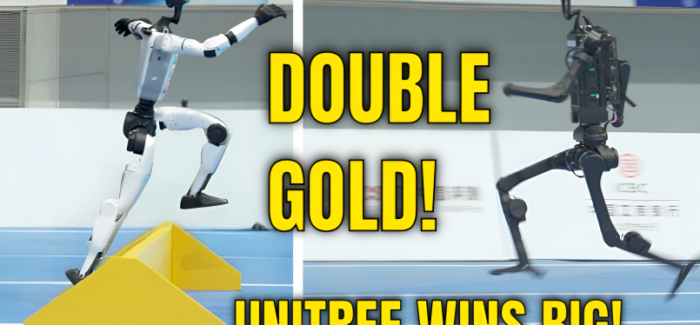
The world of robotics reached a new milestone at the first World Humanoid Robot Games in Beijing, where Unitree Robotics stole the spotlight with a stunning double gold on day one. The competition, often referred to as the “Robot Olympics,” brought together over 500 humanoid robots from 280 teams across 16 countries, testing their abilities across 26 unique events. These ranged from track and field to football, boxing, cleaning, and even medical sorting.
Among all the competing teams, Unitree proved to be the one to watch. Their H1 humanoid robot, the very same model that gained fame during the Spring Festival Gala, delivered a performance that showcased not just speed, but endurance and reliability. In the 1500-meter race, the Unitree H1 completed the distance in 6 minutes and 34.40 seconds. While still behind the human world record by nearly 3 minutes, the run was a groundbreaking moment for humanoid robots. To make things even more impressive, Unitree’s robots not only claimed first place but also secured third place, while X-Humanoid’s Tien Kung Ultra took second.
The momentum did not stop there. In the 400-meter sprint, Unitree’s H1 once again dominated, clocking in at 1 minute and 28.03 seconds. Interestingly, the real stopwatch timing was recorded at 1 minute and 23.03 seconds, highlighting just how competitive the machine has become in short-distance racing. For a humanoid robot that relies on balance, joint stability, and software coordination, this is a performance that pushes the boundaries of what many thought was possible.
Beyond the medals, the achievement carried symbolic weight. The World Humanoid Robot Games were designed to test the limits of artificial intelligence in physical form, and Unitree’s results demonstrated that humanoid robots are stepping closer to becoming more capable in real-world tasks. While the races were clean examples of locomotion, the larger event also featured comical yet insightful moments. Robots stumbled in football matches, face-planted during the opening ceremony, and sometimes needed assistance to get back on track. Despite these slip-ups, the progress in balance recovery and autonomy was undeniable.
The broader picture is about more than medals. China has invested heavily in robotics and artificial intelligence as part of its national strategy to counter demographic challenges and establish itself as a global leader in advanced technologies. The Games served as both a showcase and a proving ground for just how far humanoid robotics has come, and how much further it can go.
Unitree’s double gold sends a clear message: the future of humanoid robots is not just a concept, it is unfolding right now. With their H1 model showing dominance in both sprint and endurance, the industry has been given a glimpse of what is possible when innovation meets persistence. For enthusiasts and experts alike, it was a moment to celebrate—and a reminder that the race toward the future is well underway.
Submit a Comment