








Why Music Legends Choose Rolls-Royce Phantom: The Icon Behind the Icons
Rolls-Royce Phantom has always been more than a luxury car; it is a rolling stage where culture performs. Across 8 generations and nearly 100 years, artists have stepped into a Phantom to announce who they are, to challenge expectations, and to leave a mark that lasts well beyond the music charts. The connection runs deep because Phantom blends flawless engineering with materials and craftsmanship that feel personal, almost tailor-made for expression. That is why the world’s most creative people keep choosing it: it becomes part of their identity.
The story stretches back to the first decades of recorded music. Long before the modern pop era, names like Duke Ellington, Fred Astaire, Count Basie, Ravi Shankar, Édith Piaf, and Sam Cooke traveled by Rolls-Royce, recognizing it as a symbol of achievement and artistry. Managers and power brokers such as Brian Epstein, Berry Gordy, and Ahmet Ertegun did the same. Over time, Phantom emerged as the definitive canvas — the Rolls-Royce chosen when an artist wants the world to understand exactly who is arriving.
When Marlene Dietrich landed in California in 1930 after The Blue Angel, Paramount Studios greeted her not only with flowers but with a green Phantom I. The car even made it onto the silver screen in Morocco, sharing the spotlight with its new owner. That set a pattern: Phantom as a co-star and a storyteller.
Fast-forward to rock and roll. In 1956 Elvis Presley topped the Billboard chart with his self-titled album for 10 weeks. By 1963, “The King” owned a Midnight Blue Phantom V loaded with bespoke features: a microphone, a writing pad hidden in the rear armrest for sudden bursts of inspiration, grooming touches like a mirror and clothes brush, and the kind of presence that made every arrival feel like a premiere. A charming family detail follows the car’s lore: the original mirror-polished paint drew pecks from his mother’s chickens, forcing a repaint in Silver Blue.
John Lennon took Phantom from icon to legend. He commissioned a Phantom V in 1964 with black paint from bumper to bumper, darkened glass, a cocktail cabinet, a television, and a refrigerator in the luggage compartment. In May 1967, just before Sgt. Pepper’s Lonely Hearts Club Band, Lennon transformed it again: bright yellow paint, swirling hand-painted patterns in red, orange, green, and blue, floral side panels, and his Libra sign. For some, it captured the joy of the Summer of Love; for others, it seemed like pure rebellion. At auction in 1985, the car sold for $2,299,000 — nearly 10 times the reserve — setting records both for rock and roll memorabilia and for a motor car at auction.
Lennon owned another Phantom V, this time white, mirroring the stark minimalism of the White Album era in 1968 and his new life with Yoko Ono. Originally two-tone black over green, the car was converted inside and out for about £12,000, fitted with a sunroof, a Philips turntable, an 8-track player, a telephone, and a television. It appeared in Let It Be and in Performance with Mick Jagger, then in 1969 was sold to Allen Klein for a reported $50,000.
Liberace pushed theatricality into overdrive. At the height of his Las Vegas reign, he drove a 1961 Phantom V covered in tiny mirror pieces on stage at the Hilton. The car later appeared in the award-winning biopic Behind the Candelabra, where its brief, glittering entrance was recreated for the camera.
Sir Elton John followed in his own audacious way. In 1973, on the way to a show in Manchester in his white Phantom VI, he spotted a newer Phantom in a showroom, stopped the car, bought it on the spot, and continued to the venue. Later he blacked out the paint and interior, tinted the windows, added a television, a video player, a fax machine, and commissioned a sound system so powerful the rear glass needed reinforcement. He also owned a pink-and-white Phantom V that he eventually gifted to his percussionist Ray Cooper after a tour of the Soviet Union. Years later, Damon Albarn — the future frontman of Blur — was picked up from school in that very Phantom. In 2020, Albarn’s Gorillaz recorded “The Pink Phantom” with Sir Elton as a guest, bringing the story full circle.
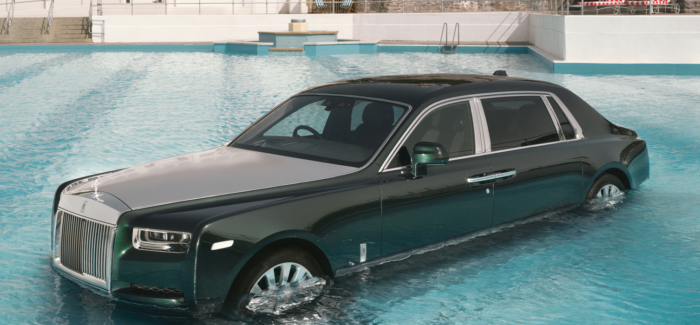
Myths shape the legend too. The tale of The Who’s drummer Keith Moon sinking a Rolls-Royce into a hotel pool during a wild 21st birthday party has been told and retold, with contradictory details and different makes of car. Whether it happened exactly that way almost does not matter; in the collective imagination, the car in the pool could only be a Rolls-Royce. To mark Phantom’s centenary and its place in rock and roll mythology, Rolls-Royce submerged a retired Extended body shell in a swimming pool at Tinside Lido in Plymouth — a celebrated Art Deco site that also links back to a 12 September 1967 photograph of The Beatles during filming for The Magical Mystery Tour.
The bond between Phantom and modern music only tightened after production moved to Goodwood in 2003. By 2016 Rolls-Royce had become the most name-checked brand in song lyrics, propelled by hip hop’s rise and Phantom VII’s presence in videos and on album covers. A Phantom VII starred in Snoop Dogg and Pharrell Williams’ 2004 “Drop It Like It’s Hot,” which reached number 1 on the United States Billboard Hot 100 for 3 weeks, while Curtis “50 Cent” Jackson appeared in Entourage in a Phantom VII Drophead Coupé — a moment that later turned into a widely shared meme. The Starlight Headliner also entered the lexicon as “stars in the roof,” a phrase that now reads like a rite of passage in rap verses.
What endures is not just luxury, but the freedom Phantom gives to define and broadcast identity. From Dietrich’s studio gift in 1930 to Lennon’s kaleidoscopic statement in 1967 to hip hop’s lyrical shout-outs, Phantom continues to be the car artists choose when they want to be seen, heard, and remembered.
Submit a Comment