








Walker S2: The First Humanoid Robot That Never Needs a Break
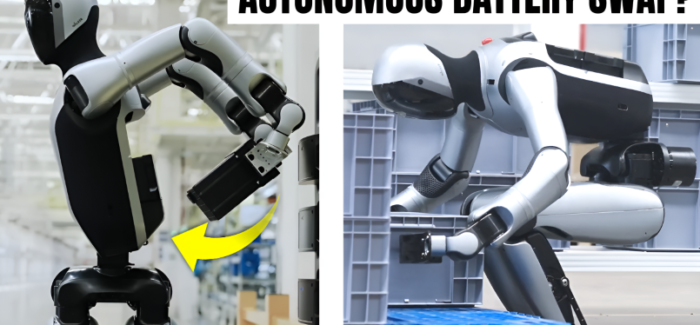
UBTECH is taking a bold step in the world of robotics with the new Walker S2. This industrial humanoid robot is not only designed to work around the clock, but it also has a unique ability that no other humanoid robot has offered before—it can change its own batteries, fully autonomously. That means no human intervention is needed to keep it powered up. When its battery runs low, it simply walks to a docking station, swaps out the drained battery, inserts a new one, and gets right back to work. The entire process takes under 3 minutes.
Standing 1.62 meters tall and weighing approximately 43 kilograms, Walker S2 is built for intelligent manufacturing, warehouse logistics, and other industrial applications. It features dual 48-volt lithium-ion battery packs that allow up to 2 hours of continuous walking or 4 hours of stationary operation. Recharging takes about 90 minutes, but with the swap feature, it never needs to stop.
The robot uses UBTECH’s BrainNet 2.0 AI system, giving it spatial awareness, task planning, and coordination with other robots. It also features RGB stereo vision for depth perception and object tracking. Its dexterous Gen-4 hands and over 50 degrees of freedom allow for precise movement and manipulation of objects up to 15 kilograms. The waist can rotate more than 160 degrees, making it agile enough to operate in tight spaces.
UBTECH is preparing Walker S2 for mass production by the end of 2025, and several companies in automotive, electronics, and logistics are already preparing to integrate these robots into their operations. Earlier versions like Walker S and Walker S1 have been tested in factories operated by companies such as Foxconn, NIO, and BYD. The S2 takes everything to the next level—more autonomy, more intelligence, and a lot more flexibility.
Walker S2 is not just another humanoid—it is the first step toward real industrial robots working nonstop alongside humans. If this is what 2025 looks like, the future of robotics is just getting started.
Submit a Comment