








Porsche Slantnose Comeback? 991 GT2 RS Test Mule Laps the Nürburgring
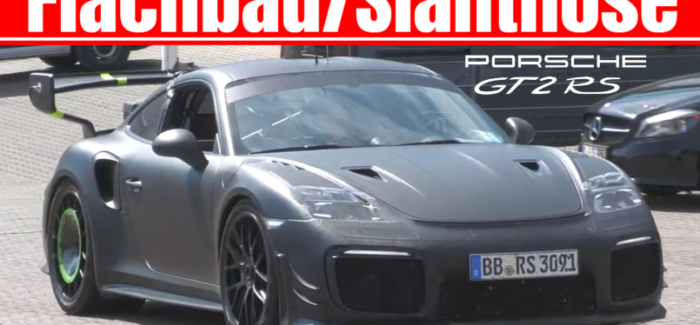
If you spend enough time trackside at the Nürburgring, you start to notice the cars that do not want to be noticed. This 911 GT2 RS test mule is exactly that kind of car: a 991 body wearing a flattened “Flachbau” face, fake headlight stickers where lamps should be, and aero that looks part prototype, part time machine. The message is subtle but clear—Porsche is experimenting with front-end packaging, and it chose a proven 991 GT2 RS shell to do it without tipping its hand on any 992 tooling.
The nose sits lower and cleaner than a standard 991, with a stretched splitter and a squared-off bumper that reads more modern 935 than classic 930 Slantnose. Removing the traditional 911 bucket headlights simplifies the airflow path over the front deck, which is almost certainly the point. A slantnose profile can reduce pressure build-up at the leading edge, helping both downforce consistency and cooling capacity. Look closely and you see signs of serious thermal management: enlarged grille area, deep ducting, and what appears to be extra extraction on the hood and around the wheel arches. That is classic Porsche mule strategy—over-cool first, fine-tune later.
The mule’s rear tells a different story: familiar 991 GT2 RS musculature, massive intakes, and a wing that does not match the catalog pieces you are used to seeing. It looks purpose-built for balance with the new front, hinting at a full aero map in development. The stance is aggressive, likely on center-lock wheels with motorsport rubber and frequent stops for tire-temperature probes. Inside, expect a lattice of data loggers, ride-height sensors, and pressure taps—nothing glamorous, everything useful.
Why build a slantnose mule now? Three reasons line up. First, heritage sells, and Porsche’s “Flachbau” name carries weight with fans who remember the 930 Special Wishes cars and the period when a 911 wore its turbocharged intent on its face. Second, the modern 935 proved that a lightly disguised GT2 RS can anchor a limited-run, track-leaning special with huge brand impact. Third, a flatter nose opens opportunities: more radiator frontal area, a different condenser layout, new brake-cooling paths, and cleaner airflow to the underbody. Testing that under camouflage on a 991 keeps attention off the specific production platform while still giving engineers a blisteringly fast baseline.
Powertrain details are a black box, but the 991 GT2 RS foundation sets a high floor: a 3.8-liter twin-turbo flat-six rated at 700 horsepower in production form. Whether this mule runs that exact tune or a development spec does not change the purpose—Porsche is correlating aerodynamic changes against a repeatable, known quantity. If this project becomes a road car, it could land anywhere on the spectrum from a Manthey Racing performance kit with slantnose cues to a factory “Flachbau RS” heritage edition with numbered build plates. The use of a 991 body does not rule out a 992-era target; Porsche has a long habit of hiding tomorrow’s ideas under yesterday’s panels.
There is also a pragmatic reason for the slantnose disguise beyond heritage. On a car as fast as a GT2 RS, stabilizing the front aero platform can pay dividends in lap-time consistency and brake behavior. A lower leading edge with smarter venting can reduce front-axle lift over crests and compressions, the Nürburgring’s calling cards. If the test logs show cleaner pressure recovery and cooler brake and coolant temps, the concept moves from nostalgia to necessity.
The wild card is the badge on the build sheet. Porsche and Manthey Racing have blurred the lines between factory and partner on previous projects, and the Nürburgring is Manthey’s living room. Wheels, hardware, and setup choices on the mule echo that playbook. Whether the finished piece wears a Stuttgart crest alone or a Manthey suffix, the intent looks the same: chase a more efficient front end and wrap it in a face that will set forums on fire.
For now, the slantnose mule remains a rolling question mark, which is exactly how Porsche likes it. The clues are all there—reworked nose, serious cooling, bespoke aero, and a test location that punishes half measures. The only thing left is the reveal.
Submit a Comment