








Nio Firefly Safety Tested: 96% Adult Score And 86% Assist—What Stands Out
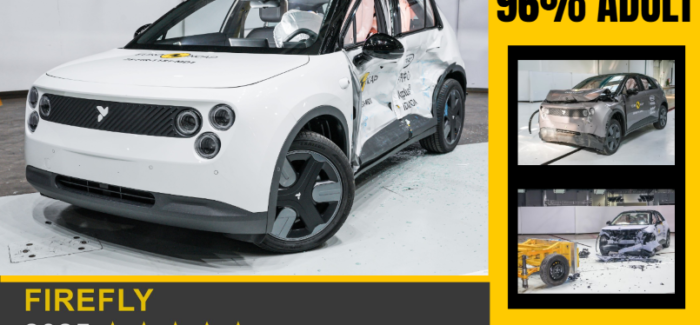
If you care about real-world safety more than buzzwords, the Firefly 5-door hatchback just delivered the goods in Euro NCAP’s 2025 testing. It posted 96% for adult occupant protection, 87% for child occupant protection, 82% for vulnerable road users, and 86% for safety assist. That is a balanced scorecard, and it tells a story: strong crash structure, thoughtful restraint tuning, and driver-assist tech that actually helps.
The cabin stayed stable in the frontal offset test and readings showed good protection for the chest, knees, and femurs. Euro NCAP also checked the car’s “impact partner” behavior in a crash, and the data indicated a benign front-end—useful for other cars’ occupants too. In the full-width barrier test, protection was good for all critical areas for the driver and at least adequate for the rear passenger. Side impacts were a highlight: the car scored maximum points in both the mobile barrier and the more severe pole test. Far-side control was rated adequate and there is a center-side countermeasure to reduce occupant-to-occupant contact. Front seat and head-restraint performance was good in rear impacts, and even the rear-seat geometry indicated solid whiplash protection. Beyond the crash lab, it is ready for emergencies with an advanced emergency call system, a multi-collision braking function, and verified door and window operability after submergence.
Parents get more than a star chart. With 87% for child occupant protection, dummy readings were good or adequate for both 6-year-old and 10-year-old sizes in frontal and side tests. The front passenger airbag can be disabled for a rearward-facing child seat, and the status is clearly communicated. Installation checks passed across the board, earning full points for child restraint system compatibility. The car also includes a direct child-presence detection system that warns if a child or infant may have been left inside. The tested restraints included a Cybex Solution Z i-Fix for the 6-year-old and an Osann Boost R129 for the 10-year-old, showing the hardware can work cleanly with common seats.
For people outside the car, the numbers are honest. Vulnerable road user protection landed at 82%. Head protection for a struck pedestrian or cyclist was largely good or adequate, with weaker results at the windscreen pillars and at the base and top of the glass—typical hard points. Protection for the pelvis was mixed but the femur, knee, and tibia zones scored strongly. The autonomous emergency braking system recognized pedestrians and cyclists, performed well in approach and crossing scenarios, and even adds cyclist-dooring prevention logic for those moments when someone flings a door into a bike’s path. Testing of responses to motorcyclists was also good.
The safety assist score of 86% reflects a mature driver-assistance suite. Intelligent speed assistance uses both camera and map data and understands sub-signs; you can allow the limiter to set itself automatically. The driver monitoring system uses direct eye tracking and looks for fatigue, microsleep, prolonged and brief distraction, and phone use from 10 km/h. Seatbelt reminders cover all seating positions. Lane support combines lane keep assist and emergency lane keeping, with a good human-machine interface and operation from 60 km/h. Autonomous emergency braking for car-to-car scenarios was strong from 4 km/h, with robust performance approaching stationary, slower, and braking vehicles as well as junction interactions. Adaptive cruise control integrates with the speed function and is accurate to within 5 km/h.
Add it all up and you get a small family car that acts big when it matters. The numbers are not just for brochures—they reflect careful engineering across crash structure, restraint logic, child safety, and active prevention. If you want a car that looks after people inside and outside, this one earns your short list.
Submit a Comment