








Is Li Auto Now Leading China’s EV SUV Battle in 2025?
Li Auto is shaking up the premium crossover segment in China with the launch of its 2025 model year L-series lineup, which includes the L6, L7, L8, and L9. These refreshed vehicles come with smarter driving tech, enhanced batteries, sleeker designs, and smoother rides—exactly what the brand needed to maintain momentum in a fiercely competitive market.
All four crossovers now benefit from an updated intelligent driving system. Starting with the Pro trim levels, each vehicle receives a rooftop LiDAR sensor from Hesai called the ATL. Built on the Hesai ATX platform, it offers a detection range of 300 meters, giving drivers a much sharper view of the road ahead. These Pro trims also swapped out their old Horizon Journey 5 chips for the more advanced Journey 6M, delivering stronger processing power.
Max and Ultra variants also received LiDAR upgrades, replacing the previous AT128 sensors. The new ATL version is 60 percent smaller, uses 55 percent less energy, and offers 130 percent higher sensitivity. These trims now run on the Nvidia Drive Thor-U chip, pushing a whopping 700 TOPS of processing power, up from the 508 TOPS delivered by the previous Orin-X dual-chip setup.
That jump in computing and sensor hardware enables the new crossovers to pull off serious safety feats. The upgraded automatic emergency braking system can now bring the vehicle to a stop from 120 kilometers per hour, even during nighttime or bad weather—critical for navigating Chinese highways safely.
Moving to the L6, it now introduces a fresh exterior paint called Azure, which costs 10,000 yuan, or around 1,385 United States dollars. Wheel designs have also been updated, and the interior receives a refined black and brown color palette. The mechanical side remains unchanged, offering a five-seater layout, 1.5-liter turbocharged engine, 36.8 kilowatt-hour battery, and dual electric motors for a total output of 300 kilowatts, or 402 horsepower. Pricing holds steady at 249,800 to 279,800 yuan.
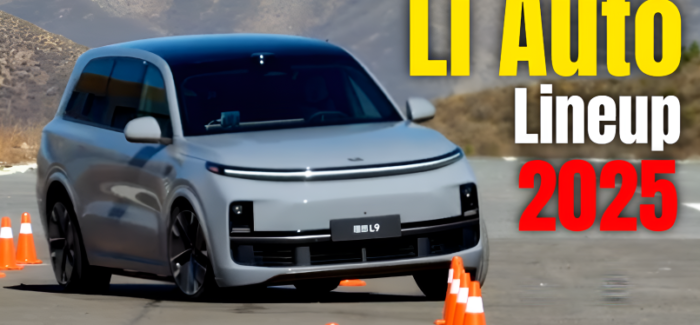
The L7 and L8 Pro trims now include a dual-chamber air suspension system, making for a stiffer and more composed ride. In testing, the L8 managed to complete the moose test at a speed of 79.47 kilometers per hour. Max trims of both models got a battery upgrade as well, moving from 42.8 to 52.3 kilowatt-hours. That boosts pure electric range to over 280 kilometers and a combined range of more than 1,400 kilometers.
The L7 is a five-seat crossover with dimensions of 5,050 by 1,995 by 1,750 millimeters and a wheelbase of 3,005 millimeters. It runs a 1.5-liter internal combustion engine and dual motors providing 330 kilowatts of output. The L8 is slightly larger, seating six people and measuring 5,080 millimeters in length. Prices range from 301,800 to 379,800 yuan.
Finally, the L9, Li Auto’s flagship, gets the most comprehensive overhaul. It now includes dual-chamber and dual-circuit air suspension, cutting body roll by 24 percent. It aced the moose test at 80.34 kilometers per hour. The interior gets a luxury boost with heated massage seats in the first and second rows and a massive 21.4-inch ceiling-mounted screen—an 86 percent increase over the old 15.7-inch unit. Add in a digital rear-view mirror and a sleek new gray exterior, and the L9 feels more premium than ever. Pricing lands between 409,800 and 439,800 yuan.
Under the hood, the L9 shares a similar powertrain with the L7 and L8 but stretches to full-size dimensions at 5,218 millimeters long, 1,998 millimeters wide, and 1,800 millimeters tall, riding on a 3,105 millimeter wheelbase.
Submit a Comment