








35 mph frontal crash test: How Safe Is the Cybertruck Beast, Really?
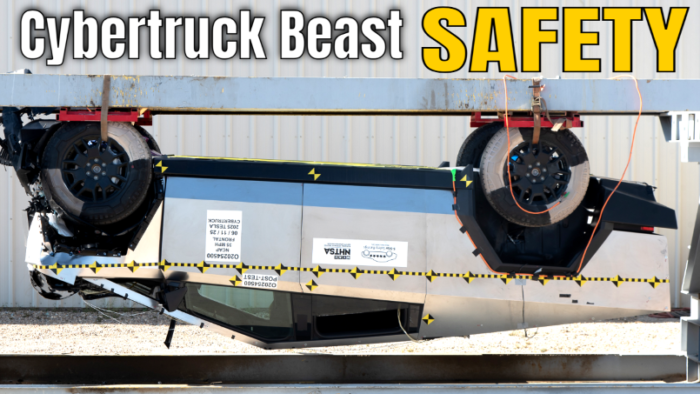
The 2025 Tesla Cybertruck Beast faced one of the most revealing assessments any new truck can meet: a full-overlap frontal impact into a rigid barrier at 35 mph under New Car Assessment Program conditions. In plain terms, this is the classic “head-on” crash that measures how well the structure, airbags, seatbelts, and restraints protect real people in real seats. For this configuration, engineers placed a 50th-percentile male dummy in the driver’s seat and a 5th-percentile female dummy up front, then recorded forces on the head, neck, chest, thighs, and lower legs while also tracking how much the cabin moved or deformed.
From the first milliseconds, the Cybertruck’s front structure did what a good crash structure should do: absorb and redirect energy before it can reach the occupants. You can see the deceleration trace in the way the front crush zone progressively collapses while the safety systems do their job. The frontal airbags deploy quickly and form a stable cushion, and the seatbelt pretensioners cinch the dummies into position so the airbags meet them at the right time, not a fraction too early or too late.
Equally important, the passenger cell behaves like a shield. The A-pillars and roof rails stay put, the footwell maintains space for feet and ankles, and there is minimal steering-column movement toward the driver. After the impact pulse clears, the doors remain closed during the crash but can be opened—an underappreciated signal that the structure is intact and first responders could reach occupants without delay.
Dummy readings tell the human story. In a strong frontal result, Head Injury Criterion stays comfortably below critical thresholds, chest acceleration and chest deflection remain controlled, and femur loads on both sides do not spike into the zones that correlate with knee or hip injury risk. Tibia indices and axial forces—good indicators for lower-leg injury—stay out of the red. That balance is what modern restraint orchestration is all about: belt load limiters sharing the work with airbags that are tuned for these exact body sizes.
Beyond numbers, the small things matter. The windshield stays bonded, keeping the cabin sealed from debris. The steering wheel and pedals return near their pre-crash positions, another indication of low intrusion. Cables, pyros, and battery protection keep thermal and electrical systems calm throughout the event so the scene remains stable.
If you care about the day-to-day safety of a large, quick electric truck, this frontal test is the baseline you want to see: a cabin that holds its shape, restraints that manage energy cleanly, and post-crash operability that makes rescue straightforward.
Submit a Comment