








2025 Corvette Safety Test: Does The Side Impact Protection Deliver?
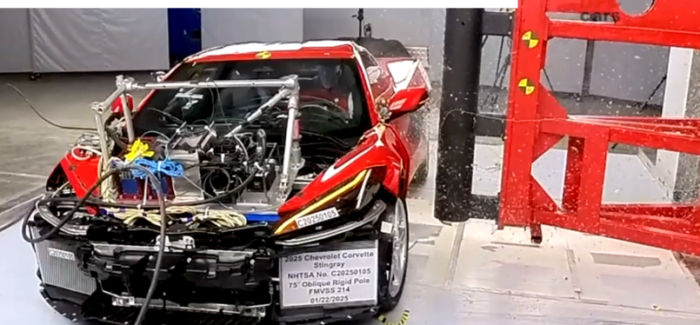
The 2025 Chevrolet Corvette did not simply show up to a lab and take a hit; it went through a carefully scripted side-pole impact that mimics one of the scariest real-world crashes—glancing off a fixed object like a tree or a utility pole. Engineers position the car at a precise angle, set the speed, and load it with high-fidelity sensors tucked into the crash test dummy and around the cabin. When the countdown ends, the Coupe meets the pole, and the data tells a story about structure, airbags, and survivability for the person inside.
This specific evaluation focuses on how well the Corvette’s side structure manages intrusion and how fast the restraints react. The door ring, sills, and floorpan are designed to route energy away from the chest and pelvis, while the curtain and thorax airbags have a split-second window to create a safe space between the occupant and the intruding pole. The timing matters as much as the force: deploy too early or too late and the protection drops. In testing, what you want to see is limited cabin intrusion, controlled dummy chest deflection, and head injury values that stay well within accepted limits, which points to a strong body and smart restraint logic.
Modern side-pole work is as much about electronics as it is about metal. The Corvette’s control unit reads the crash signature from multiple sensors, then fires the right bags with the right venting profile. That orchestration is what turns a violent, localized hit into a survivable event. Occupant kinematics—the way the body moves in those first milliseconds—must stay controlled. Good results come from a stiff side structure, a roof rail that does not fold under load, and airbags that stay inflated long enough to keep the head away from the pole.
Engineers also scrutinize what happens after the hit. Doors should not jam beyond rescue-tool access expectations, fuel systems must hold pressure without leaks, and high-voltage components remain isolated. If the restraint control flags a deploy event correctly and the post-crash protocols behave as designed, first responders get a safer environment to work in. These are the quieter wins of a good side-impact design and they matter when seconds count.
A note on dummies and numbers: the measurements are not random figures on a data sheet. Chest deflection, pelvis acceleration, and head injury criteria are surrogates for real trauma. Keeping them low is the payoff for all that structure, adhesive, ultra-high-strength steel, and airbag tuning. For a performance car like the Corvette, which sits low and already has less distance between the occupant and a pole, getting this right is non-negotiable.
Put simply, this test shows whether the Corvette’s promise of speed is matched by a plan for safety when things go wrong. The evidence from the lab points to a car engineered to keep the occupant’s head protected, the chest loads controlled, and the cabin integrity intact—exactly what you want out of a modern sports car that gets driven in the real world, not just on perfect roads.
Submit a Comment