








2024 Porsche 911 Crash Test Results Will Surprise You
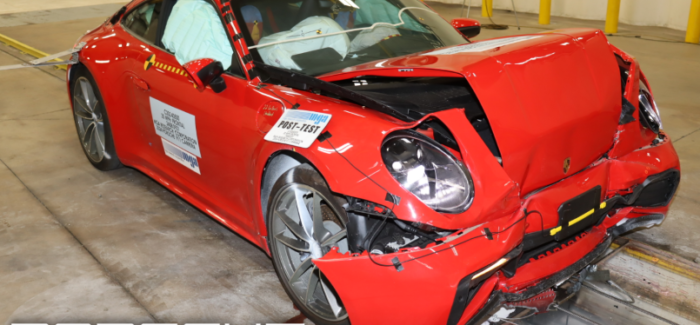
The 2024 Porsche 911 Carrera Coupe recently underwent Federal Motor Vehicle Safety Standard 208 compliance testing, and the results highlight just how far Porsche continues to push occupant safety without compromising performance. The testing was performed under the supervision of the National Highway Traffic Safety Administration and conducted by MGA Research Corporation. The series of evaluations ran from February 21, 2024, to August 9, 2024, with the final report issued in late September.
Engineers placed crash test dummies of different sizes in various positions to measure how the Porsche 911 performed in real-world accident simulations. The 50th percentile male dummy, the 5th percentile female dummy, and child dummies representing 3-year-olds and 6-year-olds were all tested in different seating arrangements. These tests went beyond basic airbag deployment. They focused on critical factors such as head injury criteria, neck loads, chest g-forces, and femur loads.
One of the more demanding tests involved a frontal impact at 56 kilometers per hour, simulating a severe collision scenario. The driver and passenger positions were equipped with 50th percentile male dummies, each belted. The results showed head injury criteria well within allowable limits, neck tension and compression comfortably below thresholds, and chest displacement values that proved the restraint systems performed exactly as intended. The numbers told a reassuring story: the Porsche 911 absorbed impact energy and distributed forces in a way that prioritized the safety of its occupants.
For younger passengers, low-risk deployment tests were performed with child dummies placed in different scenarios such as head on the instrument panel or chest on the module. The airbags deployed without creating additional risk of injury, showing that Porsche engineered a balance between restraint performance and protection for smaller, more vulnerable occupants. Even in scenarios where children were unbelted, the injury values remained far below the maximum allowable limits.
The testing also extended beyond airbags and restraints. The Porsche 911 underwent windshield mounting checks, windshield intrusion evaluation, and fuel system integrity tests. Across every category, the vehicle showed no failures. This proves Porsche’s attention to detail is not just about speed and handling but also about ensuring every safety standard is met.
For enthusiasts, this reinforces what many already know. The Porsche 911 Carrera Coupe continues to be an icon of design and performance, but it is also a reminder that safety is never compromised. These tests provide valuable confirmation that drivers and passengers alike can feel protected, even when enjoying a car built for excitement.
Submit a Comment